
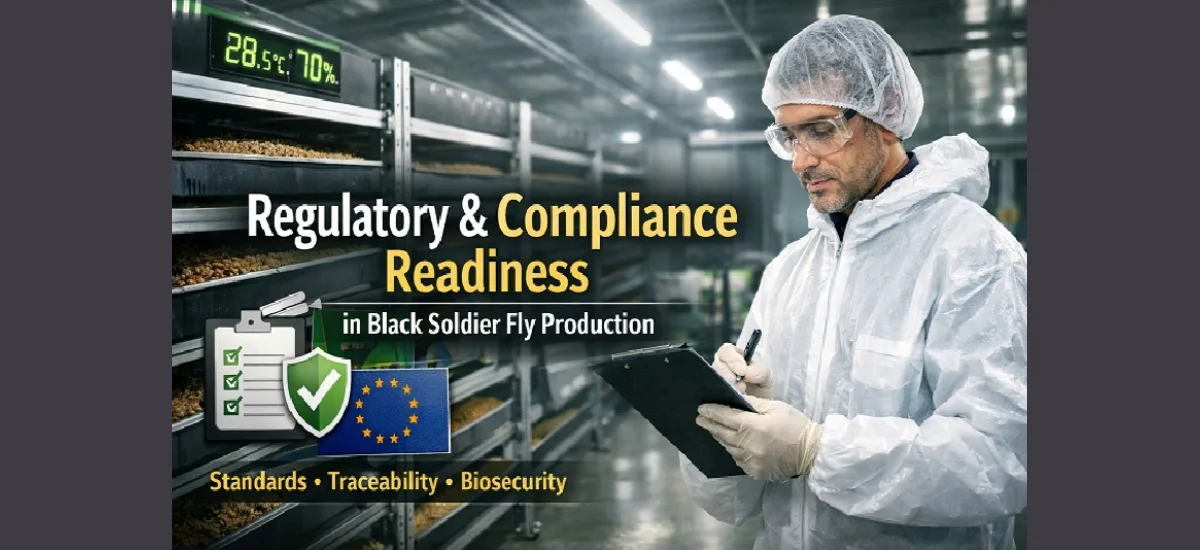
Readiness for compliance and regulation in BSF production
a.k.a. designing operations that don’t get stuck
Regulation in BSF production is hardly the most exciting part of the Black Soldier Fly operations, but it is often the part that quietly determines whether a facility can operate, scale or sell its output at all.
Problems related to regulation in BSF production projects do not arise because rules are unclear, but because compliance is treated as a paperwork task instead of an operational design requirement.
This article explains how to approach readiness for regulation in BSF production in a way that supports production instead of blocking it.
Compliance starts with process design
Permits and registrations come at the end of the process. Compliance begins much earlier, with decisions about feedstock sourcing, material flows, processing, storage, logistics, sales, and more! Facilities designed without regulatory logic often require costly retrofits once authorities get involved.
The three regulatory interfaces that matter most
Most operations interact with regulation in BSF production through three main interfaces.
1) Feedstock classification
Feedstock may be classified as waste, by-product, animal by-product, or side stream. Each of these classification affects what can be used, how it must be stored, who can supply it, and what documentation is required. And often also how your end products may or may not be used and how those are categorized, affecting sales, pricing and profitability!
Misclassification at intake is one of the most common compliance failures, and a costly one!
2) Product classification
BSF outputs may fall under animal feed, feed ingredients, fertilizers or soil improvers, or waste-derived products. The same physical material can fall under different rules depending on intended use, not composition. Clarity on product category is essential before scaling.
3) Process control and hygiene
Authorities typically focus less on insects and more on process control, hygiene practices, traceability, and risk management. Facilities with clear, documented processes usually face fewer issues, even if production is relatively simple.
Traceability is non-negotiable
At minimum, a BSF facility should be able to answer:
– Where did this batch come from?
– What feedstock was used?
– When was it produced?
– How was it processed?
– Where did it go?
Traceability does not require complex software, but it does require consistent batch logic. If batches cannot be reconstructed after the fact, compliance risk increases rapidly.
Stabilization is a regulatory issue, not just a technical one
From a regulatory perspective, stabilization determines microbial safety, storage limits, transport conditions, and product classification. Incomplete or inconsistent stabilization is a red flag for authorities, even if production volumes are small.
Effective compliance documentation reflects reality. What actually happens? What risks actually exist? How deviations are handled?
Generic templates copied from other industries often fail because they describe processes that do not exist on the ground. Inspectors tend to trust facilities where documentation matches behavior.
Small-scale operations often operate under informal tolerance. As volume increases, attention increases, expectations rise, and documentation requirements expand. Facilities that design compliance from day one scale faster than those that treat it as a future problem.
A practical compliance rule of thumb
When designing a BSF operation, ask:
Can we clearly explain our process, risks, and controls to someone who has never seen BSF production before? If not, regulatory friction is inevitable.
Readiness for regulation in BSF production is not about knowing every rule, it is about building operations that make sense to regulators. Facilities that control inputs, stabilize outputs, document reality, and maintain traceability, rarely get stuck, even as regulations evolve.
Do note however, that regulations at this point differ significantly between regions and countries. There are no single simple rules to follow, you need to dig into the regulations in your location as well as your target sales location!
Learn more about BSF farming in the
Insect Farm Hub!
Manna Insect has launched a comprehensive insect farming platform designed for learning, managing, monitoring and networking. There are tons of free content about insect farming, as well as a lot of paid premium content, that dives even deeper in black soldier fly business.
In the next article, we’ll move from compliance to strategy and examine scaling pathways and when it actually makes sense to grow BSF production.
Read also:
Monitoring and automation in BSF production
Frass handling and utilization in BSF production
Processing and stabilization in BSF production
Feedstock management in BSF production
Production capacity in BSF farming
CAPEX in BSF production
OPEX in BSF production