
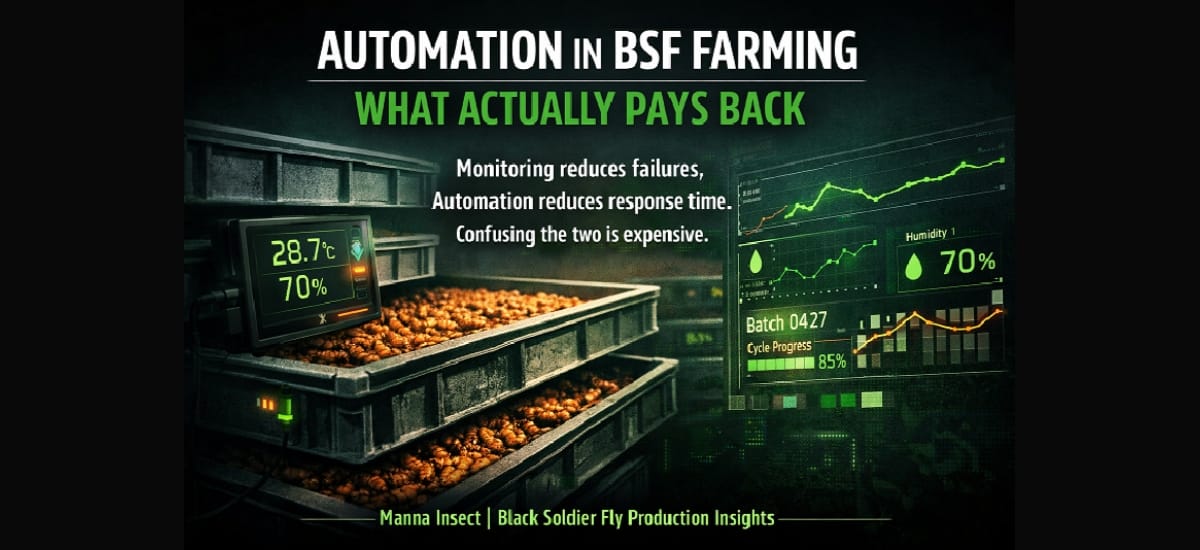
Monitoring and automation in BSF production
What actually pays back
Automation in BSF production is often presented as the key to scaling it. Robotics, AI optimization and fully automated feeding systems are frequently showcased as the future of insect farming.
In reality, most BSF facilities do not struggle because they lack automation. They struggle because they lack visibility into what is actually happening inside the production system.
Automation in BSF production only creates value when it reduces variability, prevents failures, or removes real operational bottlenecks. When implemented too early, it often accelerates problems instead of solving them.
Understanding the difference between useful automation and expensive complexity is therefore critical for anyone scaling BSF production.
Stability comes from visibility, not automation
A BSF production system does not require sophisticated automation to operate reliably. Many stable facilities still rely on relatively simple equipment and manual processes.
What they all have in common is visibility.
Production failures rarely occur because robotics or AI are missing. They occur because early warning signals go unnoticed, environmental conditions drift without detection, or corrective actions come too late.
Temperature increases inside a substrate tray, humidity drifting toward condensation levels, or slower-than-expected larval growth can develop gradually. Without monitoring, these changes often remain invisible until they already affect yields.
In practice, the stability of a BSF system depends far more on monitoring conditions than on the level of automation installed.
Monitoring usually delivers the highest early ROI
For most BSF facilities, the first digital investments that actually pay back are monitoring systems rather than automated machinery.
Reliable measurement of key variables allows operators to detect problems early and intervene before production losses occur. These variables typically include air temperature, substrate temperature, relative humidity, feedstock moisture, production cycle timing and harvest yield per batch.
Without reliable measurement of these fundamentals, introducing automation does not improve performance. Instead, automation can amplify variability by accelerating processes that are already unstable.
Facilities that invest in monitoring first usually reach operational stability faster and at lower cost.
Sensors only matter if they change decisions
Installing sensors alone does not improve production performance. Sensors create value only when the data they produce leads to operational decisions.
Each measurement point should answer a clear question. Operators need to know whether a batch is beginning to overheat, whether humidity is approaching condensation risk, or whether larval growth is deviating from expected patterns.
When sensor data triggers clear responses—such as adjusting ventilation, modifying feed composition or changing harvest timing—it becomes operationally useful. If data is collected but never acted upon, the monitoring infrastructure adds complexity without improving results.
The purpose of monitoring is not to collect data. It is to reduce uncertainty in decision-making.
Averages often hide the real problems
Many dashboards focus on average values across an entire production room. While averages can provide general insights, they often hide the signals that actually matter.
BSF monitoring becomes far more effective when operators pay attention to trends, rates of change and local deviations within the system.
A small but rapidly rising temperature in one rack can signal microbial overheating long before the average room temperature changes. Similarly, localized humidity drift may reveal ventilation imbalances or feedstock moisture problems.
Detecting these early signals allows operators to respond before a minor deviation spreads across the production system.
Where automation in BSF production genuinely improves performance
Automation can significantly improve BSF operations when it reduces human error or shortens response time to system changes.
Climate control feedback loops are one example. When ventilation and heating systems respond automatically to temperature or humidity changes, environmental stability improves dramatically. Alarm systems that notify operators when thresholds are exceeded can also prevent unnoticed failures.
Batch tracking systems are another valuable investment. Logging cycle timing, feed inputs and harvest yields helps facilities identify performance patterns and detect operational drift. Even simple automation, such as scheduled reminders for harvesting or cleaning tasks, can improve consistency across production cycles.
In these cases, automation reinforces predictability rather than replacing human oversight.
Where automation often fails to deliver ROI
Automation investments tend to disappoint when they are introduced before the underlying production system is stable.
Fully automated feeding systems rarely perform well if feedstock quality varies widely. Robotic handling systems often struggle in facilities where the layout and process flow are still evolving. Similarly, AI-driven optimization tools require reliable baseline data to function effectively.
When baseline conditions are inconsistent, algorithms attempt to optimize noise rather than meaningful patterns.
Automation in BSF production cannot compensate for poor feedstock control, undersized preprocessing capacity or inefficient facility design. Addressing these structural issues usually produces greater returns than installing additional technology.
Scaling changes the economics of automation
The role of automation in BSF production becomes more important as production scale increases.
In small facilities, manual interventions remain manageable and operators can react quickly when conditions change. Monitoring systems alone often provide sufficient visibility to maintain stability.
At larger scales, however, the consequences of failures increase significantly. A single unnoticed deviation can affect far larger volumes of biomass, and delayed responses become more costly.
This is where targeted automation begins to deliver clear economic benefits. Automated climate control, alarm systems and batch tracking reduce reaction time and limit the spread of operational problems.
The most successful facilities follow a simple sequence: stabilize the system first, automate selectively once the process behaves predictably.
A practical rule for automation decisions
A useful way to evaluate automation investments is to consider failure impact.
If a malfunction could continue for a long time before anyone notices, and the resulting production losses would be significant, monitoring or automation is likely justified.
If a failure would be quickly visible and its impact relatively small, automation may never produce meaningful returns.
This simple principle helps facilities focus on investments that actually reduce risk.
Automation is really about predictability
Automation in BSF production should not be seen as a technological showcase. Its real purpose is to improve predictability.
Facilities that perform consistently well tend to follow a similar philosophy. They monitor their systems continuously, automate selectively and prioritize investments based on operational risk rather than technological novelty.
Technology becomes valuable only when it helps operators detect problems earlier and respond faster.
Learn more about BSF farming in the
Insect Farm Hub!
Manna Insect has launched a comprehensive insect farming platform designed for learning, managing, monitoring and networking. There are tons of free content about insect farming, as well as a lot of paid premium content, that dives even deeper in black soldier fly business.
Next in the series:
The next article will move beyond internal operations and focus on regulatory readiness. We will examine how BSF facilities can be designed to avoid getting stuck in permitting and compliance processes as the industry scales.
Read also:
Processing and stabilization in BSF production
Feedstock management in BSF production
Production capacity in BSF farming
CAPEX in BSF production
OPEX in BSF production
Building a professional level BSF farm for under $10,000
Top 10 most viable BSF business cases for 2025-2026