
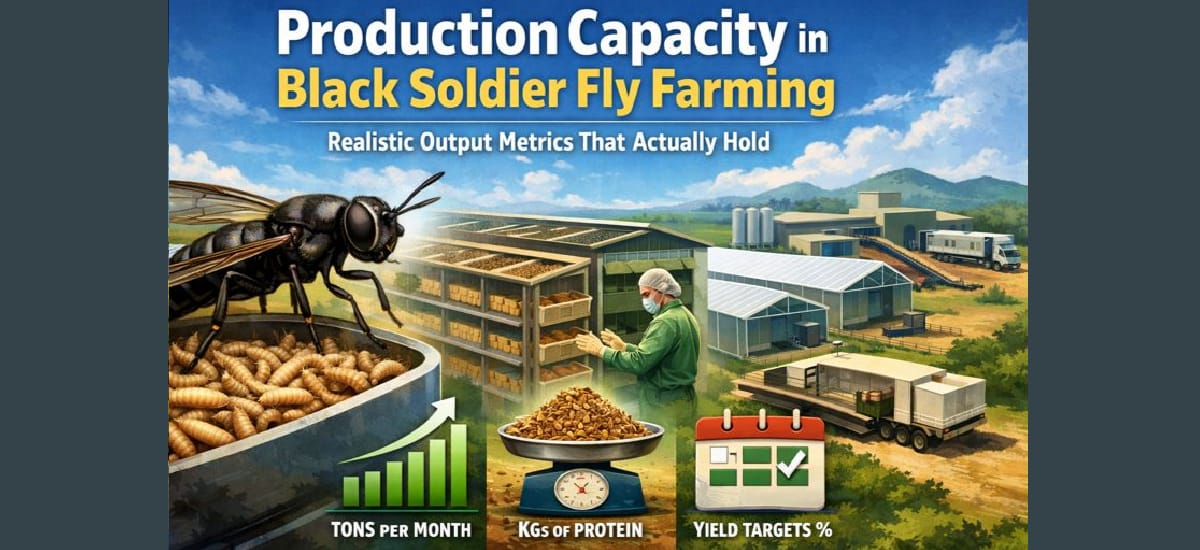
Production capacity in BSF farming: Realistic output metrics that actually hold
Production capacity is one of the most misunderstood concepts in Black Soldier Fly (BSF) farming.
Many projects are built around impressive-looking numbers — kilograms per square meter, tons per year, trays per cycle — that collapse under real operating conditions.
This article explains how to think about BSF production capacity realistically, which metrics matter, and why theoretical output almost never matches actual production.
Capacity is a system property, not a rearing number
Most BSF capacity calculations start with larvae density:
– kg larvae per tray
– trays per rack
– racks per room
While useful, these numbers describe biological potential, not production capacity.
True production capacity is limited by the slowest step in the system:
✔ Feedstock preparation
✔ Harvest and separation
✔ Drying or stabilization
✔ Internal logistics and buffer space
If any downstream step cannot keep up, rearing capacity becomes irrelevant.
The four capacity metrics that actually matter
Instead of focusing on a single headline number, BSF capacity should be evaluated using four complementary metrics.
1 ) kg of larvae per day (sustained)
This is the most honest capacity metric.
– Not peak day output
– Not best-case batch
– But average output over weeks
If a facility cannot sustain this number continuously, it is not real capacity.
2) kg per square meter (or per container)
This metric is useful — and dangerous.
It helps compare layouts, but only when:
✔ All supporting processes are included
✔ Buffer and access space is accounted for
High-density layouts often show great theoretical numbers and poor real-world performance.
3) Cycle throughput (kg per cycle × cycles per month)
BSF is a batch-based system.
Capacity depends on:
✔ How fast cycles repeat
✔ How many batches overlap
✔ How predictable harvest timing is
Missed or delayed harvests reduce annual output more than slightly lower density.
4) Annual output with downtime included
Every facility has:
– Cleaning days
– Maintenance downtime
– Batch losses
A realistic annual capacity model includes planned inefficiency, not idealized uptime.
Why “maximum density” is usually a trap
Overloading trays or bins increases:
– Heat buildup
– Moisture retention
– Growth variability
– Mortality risk
The result is often:
– Longer cycles
– Lower harvest quality
– Higher OPEX per kg
This metric works well ONLY if your climate control works properly and – vice versa – the design supports it. Facilities that aim for 85–90% of theoretical density typically outperform those chasing maximum loading.
Containers vs. buildings: capacity looks different on paper
Container-based systems
✔ Clear volume constraints
✔ Business cases (input / outputs) easy to calculate
✔ Strong discipline in layout
✔ Limited buffering capacity
Capacity planning must be conservative. Small disruptions quickly affect output.
Building-based facilities
✔ More flexibility
✔ Easier to add buffer zones
✔ Higher risk of overestimating usable space
✔ In the case of contamination or system failure the losses are significant.
Capacity errors are easier to hide — until scaling exposes them.
The hidden capacity killer: synchronization
BSF production requires synchronization between:
✔ Feeding
✔ Growth
✔ Harvest
✔ Processing
If these drift out of sync:
✔ Some batches wait too long
✔ Others are harvested too early
✔ Processing runs inefficiently
High-capacity farms are not faster — they are better synchronized.
A realistic capacity planning rule
When estimating BSF output, apply this adjustment:
Realistic sustained output = 60–75% of theoretical maximum
Projects that plan around this range are usually:
✔ Profitable sooner
✔ Easier to operate
✔ More scalable
Projects that ignore it often spend years correcting layouts and workflows.
Conclusions
Production capacity in BSF farming is not about impressive numbers, it’s about numbers that still hold after six months of operation.
The strongest operations:
✔ Underpromise
✔ Overdeliver
✔ Scale only after stability is proven
Learn more about BSF farming in the
Insect Farm Hub!
Manna Insect has launched a comprehensive insect farming platform designed for learning, managing, monitoring and networking. There are tons of free content about insect farming, as well as a lot of paid premium content, that dives even deeper in black soldier fly business.
In the next article, we’ll move deeper into the front end of the system and examine feedstock handling, variability, and their impact on output stability.
Do you already follow us in LinkedIn? We share insights and news about insect farming and BSF business daily in Manna Insect LinkedIn page, come and join the discussion!
Read also:
CAPEX in BSF production
OPEX in BSF production
Building a professional level BSF farm for under $10,000
Top 10 most viable BSF business cases for 2025-2026