
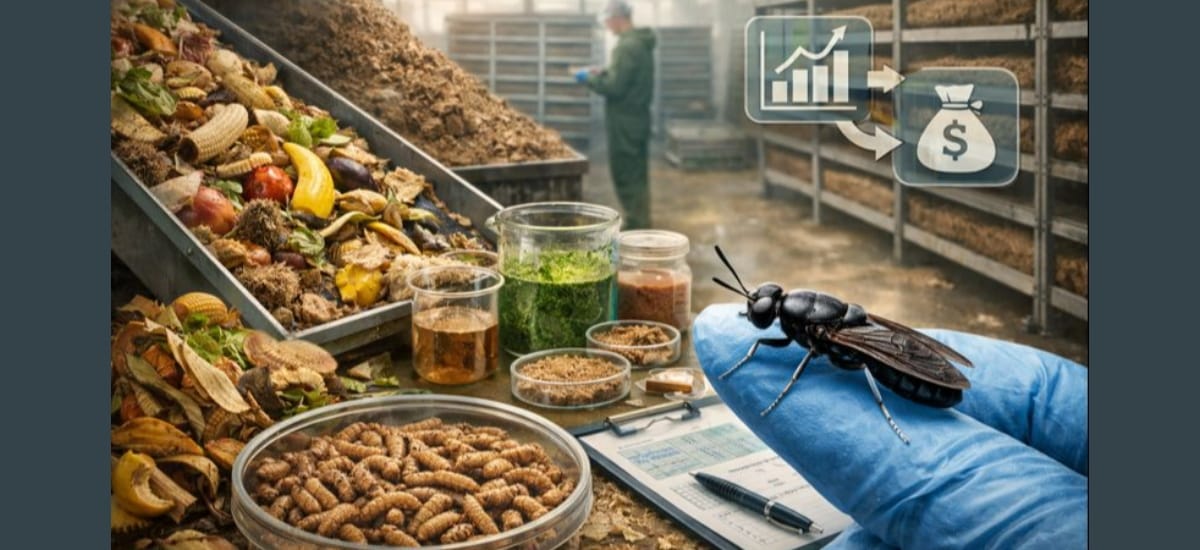
Feedstock management in BSF production: Controlling variability instead of chasing cheap inputs
Feedstock (the substrate, often biowaste) is the foundation of every Black Soldier Fly (BSF) operation, while also its most unpredictable element. While feedstock is often treated as a cost item, in practice it is a process variable that directly affects growth rate, output quality, hygiene, output consistency, and more, which makes feedstock management a very significant part of efficient production.
This article explains how feedstock variability impacts BSF production and how successful operations manage it.
Feedstock variability is the real risk, not feedstock price
BSF larvae are remarkably adaptable, but production systems are not.
Variability in feedstock causes:
– Uneven larval growth
– Growth speed
– Moisture imbalance in bins
– Increased microbial activity
– Inconsistent frass quality
– Inconsistent larvae nutritional quality affecting also the use cases
– Downstream processing inefficiencies
Many facilities fail not because feedstock is “bad,” but because it is unpredictable and varied.
The four dimensions of feedstock variability
Feedstock variability typically appears in four dimensions:
1) Moisture content
Too wet:
– Anaerobic conditions
– Odor issues
– Slower separation and drying
– Larvae escape or drown
Too dry:
– Reduced feed intake, significantly longer production time
– Lower growth rates
– Higher dust and handling losses
Stable (at the right range) moisture matters more than hitting a perfect percentage.
2) Particle size and structure
Large or uneven particles:
– Slow larval access
– Longer feeding time
– Uneven feeding zones
– Local overheating
– Frass quantity
Pre-processing to achieve consistent structure often delivers higher returns than switching feedstock types.
3) Nutrient density and balance
Sudden shifts in:
– Protein
– Fat
– Fiber
…cause delayed growth responses and unpredictable harvest timing. Gradual transitions outperform abrupt changes.
4) Microbial load
Feedstock arrives with its own biology. Unmanaged microbial activity can:
– Compete with larvae
– Increase heat and gas production
– Complicate hygiene control and cause loss of production batches
This is a process challenge, not a sanitation problem alone. Lots batches and/or production time can be very expensive!
Intake and pre-treatment: where control is gained or lost
Feedstock management starts before larvae see it.
Effective feedstock management at intake phase includes:
✔ Visual inspection and rejection criteria
✔ Moisture adjustment
✔ Particle size homogenization, smaller is better
✔ Short, controlled storage times
This stage is often underinvested in because it “doesn’t produce larvae” as such — yet it determines whether larvae production stays stable or up and running at all!
Blending beats optimization
Many operators attempt to optimize for a single “best” feedstock. In practice, blending multiple feedstocks delivers:
✔ Greater availability
✔ Lower variability
✔ More predictable outcomes
Blending smooths shocks and allows gradual transitions when inputs change. Then again, this if often a business case issues rather than production related as such. Often finding a perfect recipe for a single or standard quality input is easiest, and often also the production is built around a certain industry side stream. For those dealing with municipal or HoReCa waste mixing is a default.
Scheduling matters more than composition
Irregular feeding schedules create:
– Growth ”waves”
– Uneven bin conditions
– Synchronization problems downstream
Consistent feeding rhythm, even with somewhat imperfect feedstock, usually outperforms sporadic feeding with ideal input.
Feedstock and energy are linked
Feedstock affects:
✔ Metabolic heat generation
✔ Moisture evaporation load
✔ Drying energy demand
✔ Generally keeping the production unit environmental conditions optimal.
Wet or unstable feedstock increases energy OPEX indirectly, often without being recognized as the cause.
A practical feedstock management rule of thumb
When evaluating feedstock options, ask: “Does this feedstock reduce or increase operational variability?”
If variability increases, total production cost usually increases, regardless of feedstock price.
To be considered…
In BSF production, feedstock management is not about finding the cheapest input, it’s about building a predictable system with steady flows inwards and outwards – customers love predictability.
Facilities that treat feedstock as a controllable process variable:
✔ Achieve higher sustained output
✔ Reduce batch failures
✔ Lower total OPEX per kg
Learn more about BSF farming in the
Insect Farm Hub!
Manna Insect has launched a comprehensive insect farming platform designed for learning, managing, monitoring and networking. There are tons of free content about insect farming, as well as a lot of paid premium content, that dives even deeper in black soldier fly business.
In the next article, we’ll move deeper into operational risk and examine biosecurity, contamination, and failure prevention in BSF facilities.
Do you already follow us in LinkedIn? We share insights and news about insect farming and BSF business daily in Manna Insect LinkedIn page, come and join the discussion!
Read also:
Production capacity in BSF farming
CAPEX in BSF production
OPEX in BSF production
Building a professional level BSF farm for under $10,000
Top 10 most viable BSF business cases for 2025-2026